Why Usability Sells Better Than Immersion in VR & XR

Kirill Virovets
Product design
min read
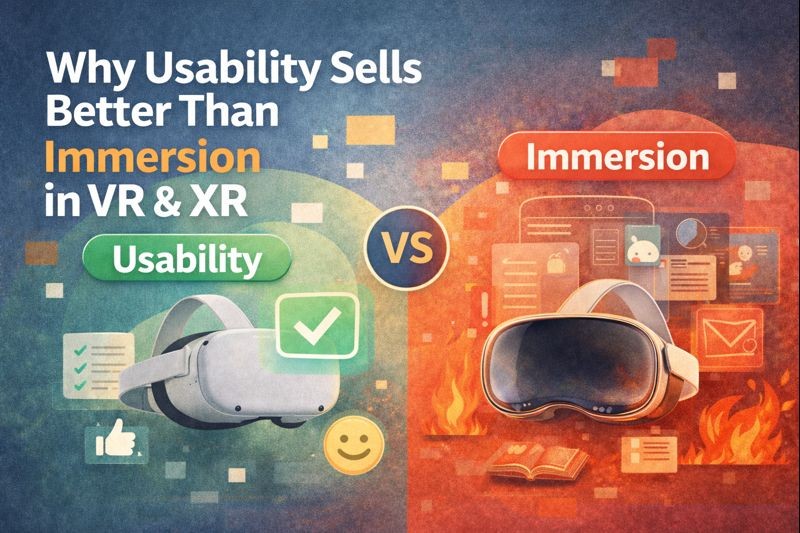
Why “Immersion” Doesn’t Sell — but Usability Does
VR, XR, and Spatial Product Development Perspective
“Immersive” is one of the most overused words in VR and XR marketing.
It sounds impressive in demos, pitch decks, and trailers.
But in real products, immersion rarely sells on its own.
What actually drives adoption, retention, and long-term value in VR, MR, and XR products is something much less flashy: usability.
The problem with selling immersion
Immersion is abstract.
Users can’t clearly imagine what it means before they try the product.
When people hear “immersive VR experience,” they don’t understand:
how easy it is to use
how comfortable it feels
how much effort it requires
whether it fits into their daily life
As a result, immersion works poorly as a value proposition. It promises emotion, but hides cost — physical, cognitive, and emotional.
Once users actually try the product, immersion becomes secondary. What they notice first is friction.
What users actually care about in VR and XR
In real usage, people don’t open VR or XR apps to be impressed.
They open them to do something.
That could be:
watching content
training
learning
working
interacting
completing a task
In all these cases, users immediately evaluate:
Is it comfortable?
Is it clear what to do?
Does it feel predictable?
Can I control it without thinking?
If the answer is “no,” immersion doesn’t matter.
The user leaves.
Usability is what makes immersion possible
This is the key mistake many teams make in VR product development.
They try to add immersion instead of earning it.
In reality:
smooth performance creates comfort
clear interaction reduces cognitive load
predictable UX builds trust
physical-friendly design prevents fatigue
When usability is high, users stop noticing the interface.
Only then does immersion appear.
Immersion is not a feature.
It is a side effect of good UX.
Why usability converts better than immersion
From a business perspective, usability has clear advantages.
It directly impacts:
onboarding success
first-session retention
repeat usage
user confidence
word-of-mouth
Immersion, on the other hand, is hard to measure and easy to overpromise.
That’s why many successful VR, MR, and XR products don’t sell immersion at all. They sell:
ease of use
comfort
speed
reliability
Immersion happens naturally — after trust is built.
Spatial products amplify usability problems
In spatial computing, every UX mistake costs more.
A confusing button in mobile is annoying.
A confusing interaction in VR is exhausting.
Because VR and XR interfaces are physical:
bad UX causes fatigue
unclear flows increase churn
over-designed visuals overwhelm users
This makes usability even more critical in spatial product design than in traditional apps.
Why “wow effect” doesn’t scale
Many VR products rely on a strong first impression.
The “wow effect” works once.
But novelty fades quickly.
If the product isn’t comfortable or convenient, users don’t come back. Immersion without usability leads to:
short sessions
low retention
poor long-term metrics
That’s why usability is what scales — not spectacle.
The right way to think about immersion
A healthier framing for VR and XR development is simple:
Don’t ask:
“How immersive is this?”
Ask instead:
“How effortless does this feel?”
If the product feels effortless:
immersion will follow
users will stay longer
adoption will grow naturally
Final thought
Immersion is not what users buy.
It’s what they experience after usability is solved.
In VR and XR products:
usability sells
comfort retains
immersion emerges
Teams that understand this build products people actually use —
not just admire in demos.
Stay informed with the latest guides and news.