R&D vs Production ML: How to Build Real AI Products

Kirill Virovets
Web design
min read
R&D vs Production ML: Why Most Machine Learning Ideas Fail in Real Products
A Guide for ML Development and MLOps Teams
Most machine learning ideas don’t fail in research.
They fail in production ML.
This is one of the hardest lessons in machine learning development. Models that look great in notebooks and presentations often collapse when they meet real users, real data, and real infrastructure.
Understanding the difference between R&D ML and production ML systems is critical if you want to build scalable, reliable AI products.
Why ML looks successful in research
In R&D, the environment is controlled.
You work with static datasets, carefully labeled samples, and clean distributions. You optimize for offline metrics like accuracy, precision, recall, or F1 score.
Your goal here is simple:
Can the model work at all?
And in many cases, it can.
But this stage ignores the real-world complexity of ML engineering:
changing user behavior
noisy data
infrastructure limits
product constraints
A research model proves possibility, not viability.
What changes in production ML systems
Production ML lives in chaos.
Once deployed:
data distributions drift
new edge cases appear
inference latency matters
cloud costs become visible
user feedback becomes real
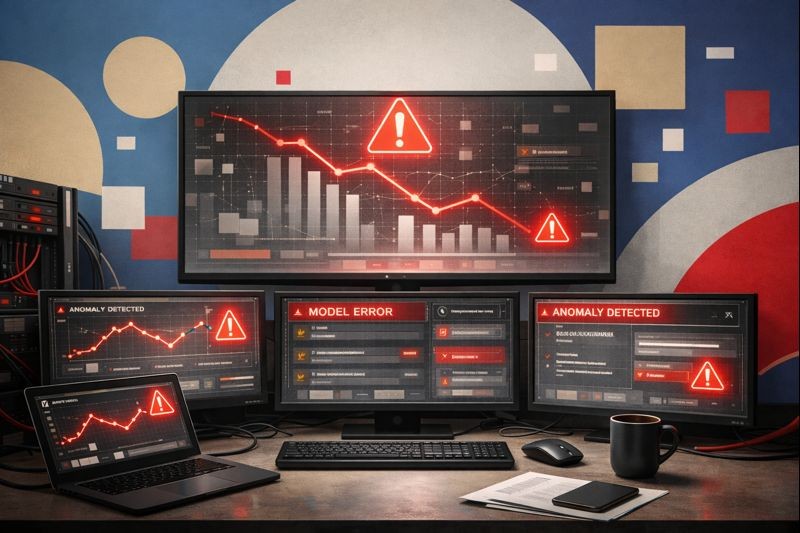
Your model still runs, but performance slowly degrades.
Predictions become less reliable.
False positives increase.
Business metrics start dropping.
This is where most machine learning projects quietly die.
Not because the model is bad.
But because nobody planned production.
The biggest killers of ML ideas
Most failures are not technical.
They are product and process failures.
Common problems in ML development:
No clear business metric
Teams optimize accuracy instead of revenue, retention, or conversion.
No ownership
After release, nobody “owns” the model.
No monitoring
Silent failures go unnoticed for months.
No retraining strategy
Models become outdated as data changes.
No feedback loop
User behavior never reaches the ML team.
This is why production ML requires much more than model training.
The gap between “model ready” and “production ready”
One of the biggest misconceptions in ML engineering is:
If the model works offline, it will work in production.
This is false.
Production ML requires:
data pipelines
feature stores
monitoring dashboards
alerting systems
automated retraining
rollback strategies
Without MLOps, your model is just a prototype.
The real challenge of ML development
Training models is the easy part.
The hard part is:
keeping them stable
keeping them relevant
aligning them with business goals
Models rarely fail suddenly.
They decay slowly.
And slow failure is the most dangerous one.
What production-first ML looks like
Strong ML teams think about production from day one.
Before training, they ask:
What business metric are we optimizing?
How will we detect performance drops?
Who owns the model after release?
How often will we retrain?
What happens if it breaks?
This mindset separates research ML from real ML products.
Why MLOps is critical
MLOps connects:
data engineering
ML development
production infrastructure
Without MLOps:
models rot
costs explode
teams lose trust in ML
Production ML is not a one-time event.
It’s a continuous system.
Final thoughts
If your ML roadmap ends at
“model ready”
you don’t have a product strategy.
You have a demo.
Real machine learning products are built in production.
Not in notebooks.
And that’s where most ML ideas truly die.
Stay informed with the latest guides and news.