Why Onboarding in VR/XR Is a Core Feature

Kirill Virovets
Web design
min read
Why Onboarding in VR Is a Core Feature
XR, VR, and Spatial Product Development Insights
In traditional apps, onboarding is often treated as a secondary layer. A tutorial, a tooltip, or a short walkthrough that explains how things work. In VR and XR products, this approach fails.
In immersive environments, onboarding is not an addition to the product.
It is the product.
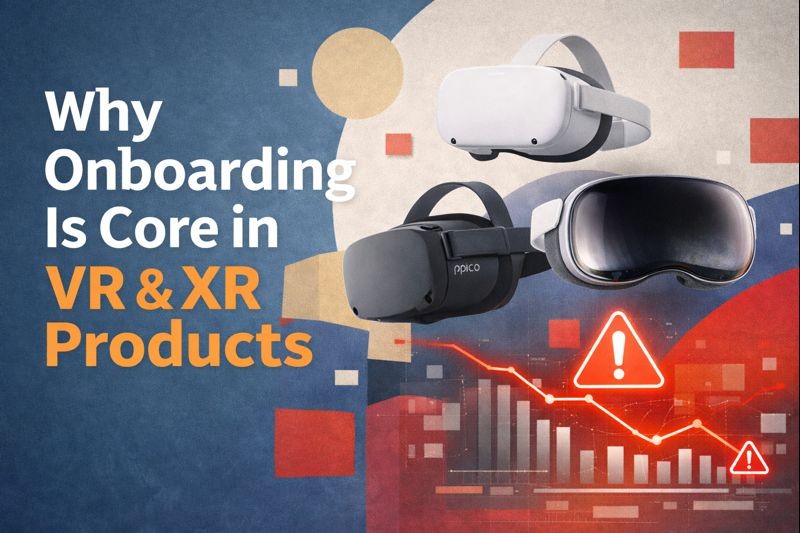
This is especially true for spatial products built for headsets like Meta Quest, Apple Vision Pro, and Pico.
VR onboarding starts the moment the headset is on
In VR, the user’s first interaction begins before any UI appears. The moment someone puts on a headset, their brain starts adapting to a new spatial environment. Depth, scale, movement, controllers or hand tracking — everything is unfamiliar.
Unlike mobile or desktop apps, users can’t rely on learned interaction patterns. There is no scrolling, no quick scanning, no instinctive tapping. Every action requires physical movement and cognitive effort.
That means onboarding in VR doesn’t start with a tutorial screen.
It starts with how the first interaction feels.
Why traditional onboarding fails in VR and XR
Many VR and XR products try to copy onboarding patterns from 2D apps. They add instruction panels, text hints, or step-by-step explanations. On paper, this looks reasonable.
In reality, users ignore them.
Reading text in VR is uncomfortable. Cognitive load is already high. The user is busy understanding space, controls, and their own body position. Adding instructions on top of that overwhelms them.
On devices like Meta Quest and Pico, poor onboarding often leads to immediate churn. On Apple Vision Pro, users may tolerate more complexity, but they still expect clarity and natural interaction. If the first experience feels confusing, users simply close the app.
Onboarding defines comfort, not just understanding
In VR, onboarding is tightly connected to comfort.
The first session teaches the user:
how to move
how to interact
how much effort is required
whether the experience feels safe
If onboarding introduces discomfort — through bad motion design, unclear controls, or overwhelming UI — users associate that discomfort with the product itself.
From a metrics perspective, this directly impacts:
first-session retention
session completion
long-term usage
A broken onboarding flow means the core VR feature is broken, no matter how good the content is later.
Spatial products must teach through interaction
Successful XR and spatial products don’t explain how they work. They demonstrate it.
Instead of instructions, they rely on:
learning by doing
visual and spatial cues
environmental guidance
constrained interactions that prevent mistakes
This approach works across platforms — from Quest to Vision Pro — because it aligns with how humans learn in physical space.
The interface becomes invisible. The environment itself explains the rules.
Why onboarding is a core feature, not a phase
In VR and XR development, onboarding is not something you “finish.” It’s something you continuously refine.
Every new feature changes:
how users move
where they look
how they interact
That means onboarding is embedded into the core UX and interaction design. It evolves with the product.
Treating onboarding as a one-time flow is a common mistake in VR product development and XR app design.
Business impact for VR and XR products
From a business perspective, onboarding in VR directly affects:
retention
churn
user trust
perceived product quality
In immersive products, users decide very quickly whether the experience feels “right.” If the first session fails, no roadmap can fix it later.
That’s why teams building VR, MR, and XR products must treat onboarding as a core feature, not as documentation.
Final thought
VR and XR are not extensions of mobile or desktop platforms.
They are new mediums.
And in new mediums, users don’t read instructions.
They learn through experience.
If your VR onboarding is broken, your product is broken —
because in immersive environments, onboarding is the core feature.
Stay informed with the latest guides and news.