How MR Products Differ from VR Products at the Metrics Level

Kirill Virovets
Product design
min read
How MR Products Differ from VR Products at the Metrics Level
With Real Examples from Vision Pro and Meta Quest
VR, MR, and XR are often discussed as if they belong to the same product category. In practice, this is one of the biggest analytical mistakes teams make when building immersive products. While the hardware may look similar, user behavior — and therefore product metrics — differ dramatically between VR and MR experiences.
If you measure an MR product using VR metrics, you will inevitably optimize the wrong things. Session length, immersion time, and “wow effect” might look good on dashboards, but they often hide real product problems. To build successful XR products, we need to understand what people actually do inside headsets — and why.
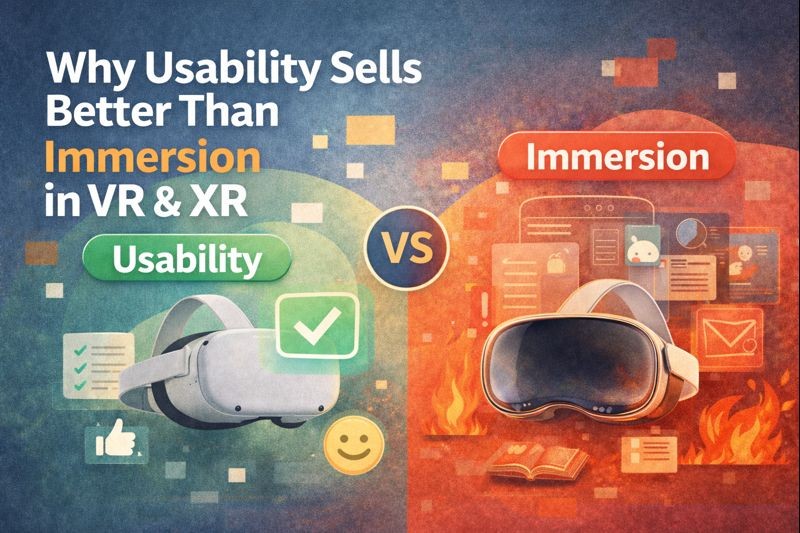
The core difference: immersion vs integration
The fundamental difference between VR and MR products lies in their purpose.
VR products aim to fully immerse users in a digital world. When someone puts on a Meta Quest headset to watch a movie, play a game, or explore a virtual space, the goal is to disconnect from reality. Success is measured by how long the user stays inside the experience and how deeply they engage with it.
MR products, especially on devices like Apple Vision Pro, work in the opposite direction. Instead of isolating users, they integrate digital interfaces into real life. The user is not escaping reality — they are enhancing it. This single difference completely changes how metrics should be interpreted.
How metrics work in VR (Meta Quest example)
Let’s take Meta Quest as a typical VR use case.
Most VR apps on Quest are built around entertainment: games, video players, social VR, virtual worlds. Users intentionally block out the real world, put on the headset, and commit to the session. Because of this, session length becomes a primary metric. A 20-minute session is often considered better than a 5-minute one.
Retention in VR is strongly connected to physical comfort. Frame rate stability, low latency, and smooth locomotion directly impact whether users come back. A small FPS drop or motion sickness issue may not show up as a “bug” in logs, but it will instantly appear in retention metrics.
Another common VR metric is content completion. Did the user finish the video? Did they complete the level? Did they reach the end of the experience? These numbers matter because VR users usually commit to a single activity per session.
In short, VR success is about depth. Fewer sessions, but longer and more immersive.
How metrics work in MR (Vision Pro example)
Now let’s look at Apple Vision Pro and MR products.
Vision Pro users rarely “commit” to long sessions. They use apps while staying connected to their physical environment. They might check a message, resize a window, talk to someone, or move around the room. Context switching is normal, not a problem.
Because of this, session duration becomes a weak metric. A user may open your MR app ten times a day for 20–30 seconds. From a VR perspective, this looks like bad engagement. From an MR perspective, this is perfect behavior.
Instead of session length, frequency becomes the core metric. How often does the user return? How often do they repeat the same action? This is where “return-to-task rate” becomes extremely important. If a user comes back every day to perform the same task, your product is winning.
In MR, task completion rate matters more than immersion. Did the user finish what they came for? Did the interface help them act faster? Did it reduce friction? This is closer to productivity software metrics than gaming metrics.
Vision Pro also highlights a critical MR metric: interruption tolerance. Can your product survive when the user is distracted? If a phone rings or someone walks into the room, does the user easily continue what they were doing? MR products must be interruption-friendly by design.
In short, MR success is about integration. Many short interactions that blend into daily life.
Why VR metrics fail in MR products
One of the most common mistakes in XR development is applying VR metrics to MR products.
Teams track session length and conclude:
“Users don’t spend much time in our MR app. Engagement is low.”
But in reality, the product might be extremely successful. Users may open it dozens of times per day to solve small tasks. Measuring MR with VR logic makes healthy behavior look like failure.
Another mistake is chasing immersion in MR. Developers try to create cinematic flows, heavy animations, and long onboarding sequences. But MR users don’t want to be impressed. They want speed. They want utility. They want to finish and move on.
XR products: combining both worlds
XR products often sit between VR and MR. Some features require immersion, while others require quick interactions. This makes analytics more complex.
For example, a VR video player may have:
– long immersive viewing sessions
– short MR-style interactions for browsing content
In this case, you must track both:
– depth metrics (session length, completion)
– frequency metrics (return-to-task, daily usage)
XR analytics is about balance. The mistake is choosing only one model.
Practical takeaway for developers
Before choosing metrics, you should ask a simple question:
Is this product about immersion or about integration?
If your answer is immersion — you’re building VR.
If your answer is integration — you’re building MR.
That answer should define:
– your UX
– your onboarding
– your roadmap
– your analytics
– your growth strategy
Metrics are not universal. They must follow behavior.
Final thought
VR and MR may share hardware, but they do not share product logic.
Meta Quest teaches us how immersion works.
Vision Pro teaches us how integration works.
If you build MR like VR, you will lose users.
If you measure MR like VR, you will misread reality.
Different medium → different metrics → different success.
Stay informed with the latest guides and news.